
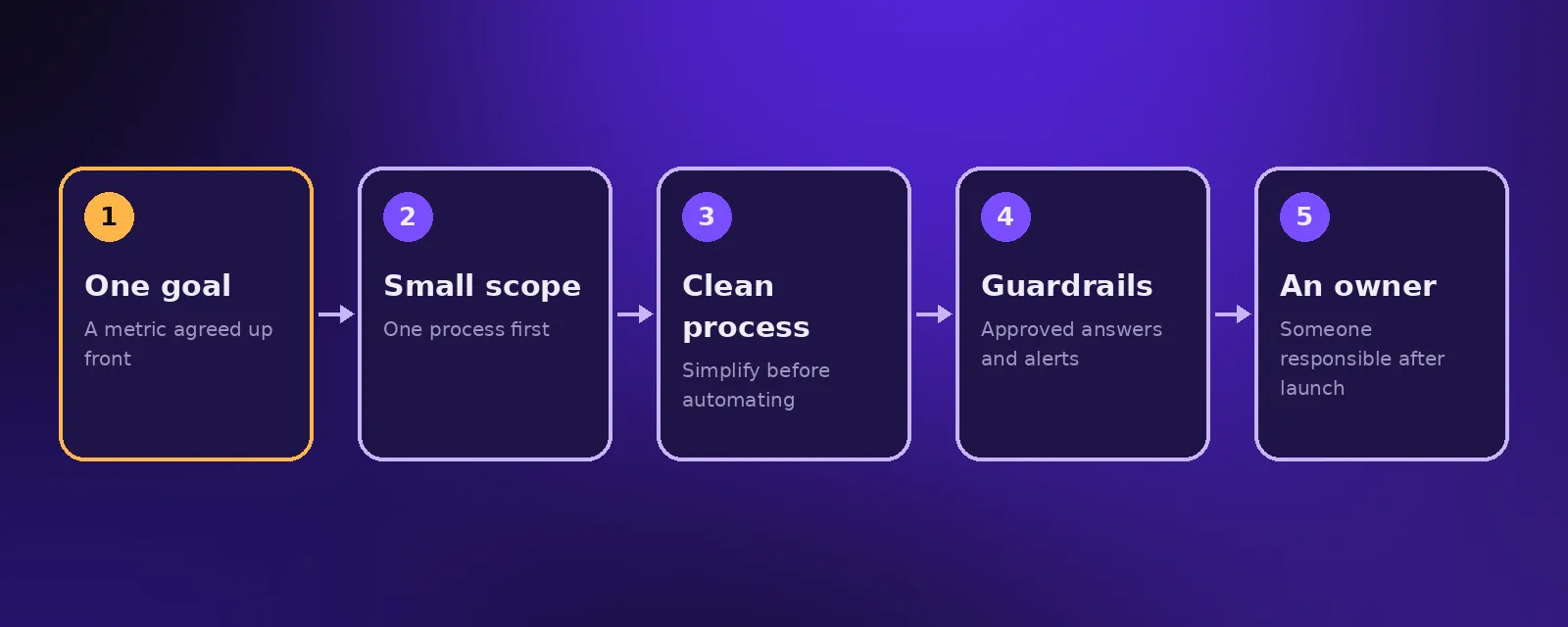
- Most AI automation projects fail for business reasons, not technical ones: vague goals, too much scope, messy processes and nobody owning the result.
- Technical failures come from fragile integrations, no error alerts, AI without guardrails and no testing with real data.
- Start small, measure one outcome, build in your own accounts and plan for maintenance from day one.
Plenty of companies have tried AI automation and been disappointed: a chatbot nobody used, a workflow that broke after a month, a big project that never launched. The causes are surprisingly consistent. Here are the reasons AI automation projects fail and how to avoid each one.
1. No clear goal
"Use AI" is not a goal. "Reply to every new lead within one minute" is. Without a measurable outcome nobody can tell whether the project worked. Fix: pick one metric before you start.
2. Trying to automate everything at once
Large programmes stall under their own weight. Fix: start with one frequent, costly, predictable process, prove it, then expand.
3. Automating a broken process
If the manual process is unclear, the automation will be too, and it will make mistakes faster. Fix: map and simplify the process first. See business process automation.
4. Choosing the tool before the problem
Buying a platform and then looking for uses leads to shelfware. Fix: define the process and requirements, then choose the tools. See automation software.
5. AI without guardrails
An agent that answers from general knowledge will eventually say something wrong. Fix: ground answers in approved information, limit scope and add a human handoff. See how to build AI agents.
6. No testing with real data
Demos use clean examples. Real customers write in slang, send photos and ask two things at once. Fix: test with real conversations and edge cases before launch.
7. Silent failures
An integration fails, nobody notices, and leads disappear for weeks. Fix: error handling, retries and alerts on every workflow.
8. Nobody owns it
When the person who built it leaves, the automation slowly breaks. Fix: name an owner, document everything and build inside accounts the business controls.
9. The team is not on board
Staff who see AI as a threat will work around it. Fix: involve them early, show how it removes the tasks they dislike, and train them on the handoff.
10. No plan after launch
AI systems improve with tuning. Fix: review results monthly and keep improving instructions, knowledge and workflows.
How Acceltor avoids these failures
Every project starts with a free audit, a written blueprint and one fixed quote. We build in your accounts, test with real scenarios, add alerts and stay involved after launch. Learn more about what an AI automation agency does.
Frequently asked questions
Why do AI automation projects fail?
Usually because of vague goals, too much scope, messy processes, missing guardrails, no testing with real data, silent failures and nobody owning the system after launch.
What percentage of AI projects fail?
Estimates vary widely between studies, but most agree that a large share of AI projects never reach production or deliver less than expected, mainly for organisational reasons.
How can small businesses succeed with AI automation?
Start with one process that clearly costs time or revenue, set a measurable goal, launch quickly, measure the result and expand from there.
Should we build AI automation in house or hire an agency?
Build in house if you have technical staff with time to maintain it. Hire an agency when you need it done quickly and properly, with ownership handed to you.

Founder and CEO of Acceltor. Talha leads a team of engineers and designers building AI agents, automations, websites and apps for growing businesses.
Meet the team →