
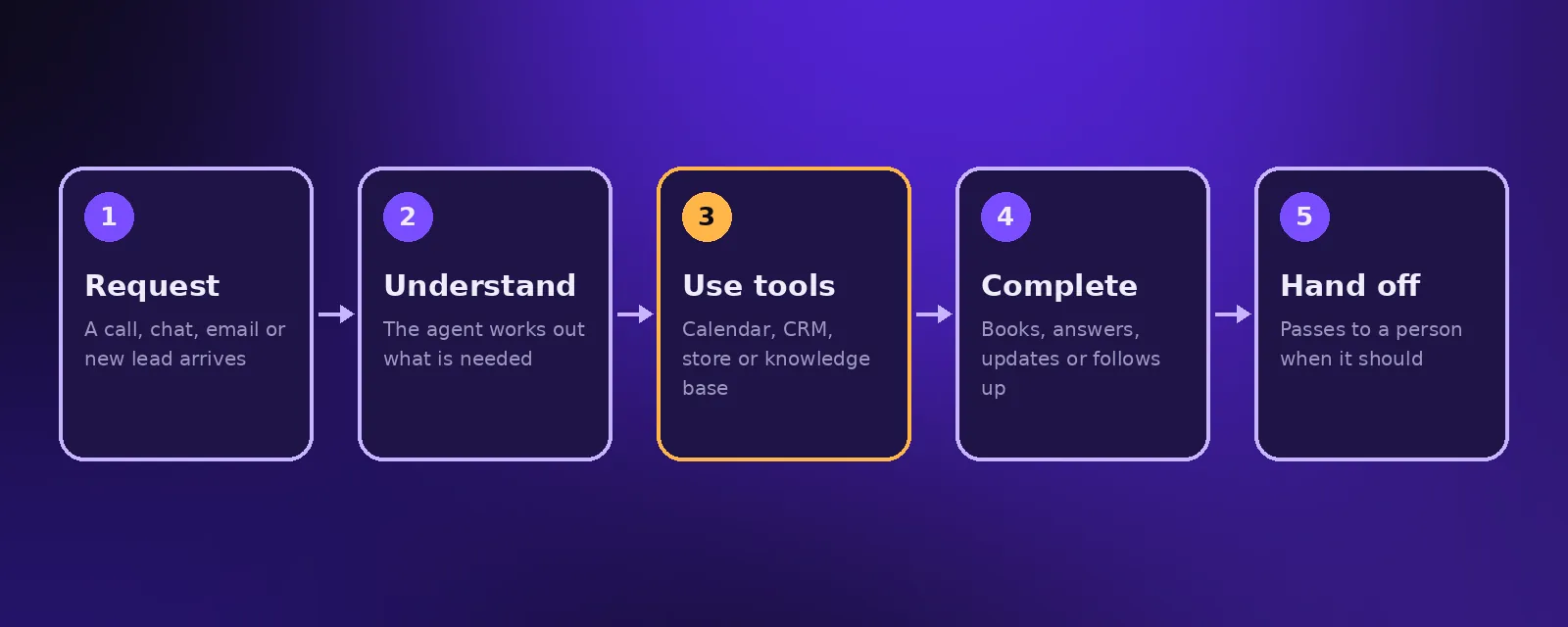
- AI agents for business are software assistants that understand requests, use your tools and complete tasks, rather than only answering questions.
- The best first use cases are high volume, repetitive and rule guided: answering calls, replying to messages, qualifying leads, booking appointments and updating records.
- Start with one agent tied to one measurable goal, give it clear guardrails and a human handoff, then expand.
An AI agent is more than a chatbot. A chatbot answers questions. An agent understands what someone needs, decides what to do next, uses your business tools to do it, and reports back. For a growing business that means fewer missed calls, faster replies to leads and far less copy and paste work for your team.
What is an AI agent?
An AI agent combines a language model with instructions, access to tools and a memory of the conversation. Given a goal, such as booking an appointment, it can ask the right questions, check your calendar, create the booking, send a confirmation and log everything in your CRM. Crucially, it works inside limits you set and hands over to a person when a request falls outside them.
9 practical AI agent use cases for business
1. AI receptionist for inbound calls
A voice agent answers every call on the first ring, day or night, answers questions about prices, hours and services, and books appointments. This is especially valuable for clinics, salons, restaurants and home service businesses where staff cannot always pick up. See AI voice agents.
2. Missed call and new lead callbacks
The agent calls back missed calls and fresh form or ad leads within minutes, while interest is high, and qualifies them before passing them to sales.
3. Website and WhatsApp chat agent
Trained on your services and policies, the agent replies on your website, WhatsApp, Instagram and Messenger in seconds and captures contact details. See AI chat agents.
4. Appointment booking and reminders
Agents check live availability, book the right person and slot, send reminders and offer cancelled slots to a waiting list, which helps reduce no shows.
5. Lead qualification
Before a salesperson spends time on a lead, the agent asks about budget, timeline and needs, scores the lead and routes it to the right person.
6. Customer support for common questions
Order status, opening hours, return policies and preparation instructions can be answered instantly, with complex cases escalated to your team with full context.
7. CRM updates and data entry
After every call or chat the agent updates contact records, deal stages and notes, so your pipeline stays accurate without manual entry. See CRM setup.
8. Document processing
Agents can read invoices, forms and contracts, pull out the key data and put it where it belongs. See custom AI tools.
9. Reporting and summaries
An agent can gather data from several systems and post a plain language summary to Slack or email every week, so managers see what matters without building reports.
How to choose the best first AI agent for your business
Score each idea on three things: how often the task happens, how much time or revenue it costs today, and how predictable the right answer is. The best first projects are frequent, costly and predictable. Answering calls and following up leads usually win on all three.
Guardrails that make AI agents safe to use
- Approved knowledge. The agent answers from your own information, not guesses.
- Clear limits. Topics it must not handle, such as medical or legal advice, are defined up front.
- Human handoff. Anything outside its limits is transferred to a person with the conversation attached.
- Review. Transcripts and outcomes are reviewed regularly so the agent keeps improving.
What AI agents cost
Costs depend on volume and complexity. Acceltor's AI conversational agent plans start at $299 a month with included agent minutes, and cover calls, chat and messaging. See our pricing for every plan.
Frequently asked questions
What is the difference between an AI agent and a chatbot?
A chatbot mainly answers questions. An AI agent can also take actions, such as booking appointments, updating your CRM or sending follow ups, using the tools you connect to it.
Can AI agents replace my staff?
AI agents work best taking over repetitive, high volume tasks so your staff can focus on work that needs a person, such as complex customer issues and closing sales.
Which industries benefit most from AI agents?
Any business that handles many calls, messages or bookings benefits, including clinics, dental practices, salons, restaurants, real estate, home services, law firms, ecommerce and agencies.
How long does it take to launch an AI agent?
Most chat agents go live in one to two weeks and voice agents in two to three weeks, including testing with real scenarios.

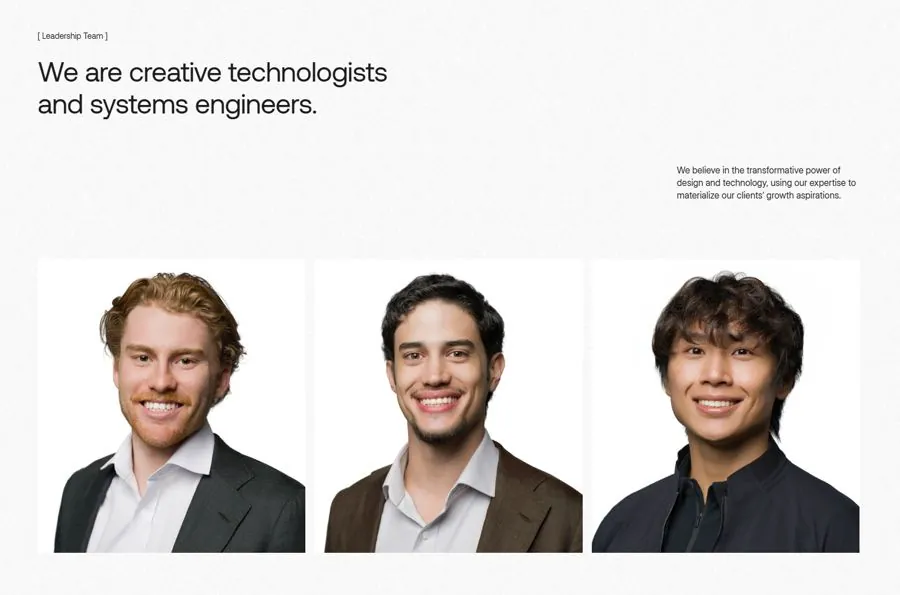
Founder and CEO of Acceltor. Talha leads a team of engineers and designers building AI agents, automations, websites and apps for growing businesses.
Meet the team →