

- Robotic process automation (RPA) uses software bots to repeat rule based tasks, often by mimicking clicks and keystrokes in existing applications.
- Intelligent process automation (IPA) adds AI to RPA and workflows, so automation can read documents, understand language and make simple decisions.
- Hyperautomation is the strategy of automating as many processes as possible by combining RPA, AI, workflow tools and integrations.
RPA, intelligent automation and hyperautomation are often used as if they mean the same thing. They are related, but each describes a different level of automation. Understanding the difference helps you pick the right approach and avoid paying for more than you need.
What is robotic process automation (RPA)?
Robotic process automation uses software bots to carry out repetitive, rule based tasks the way a person would: opening applications, copying data, filling in forms and clicking buttons. RPA is useful when a system has no API and the only way to automate it is through its screen. Tools such as UI.Vision RPA work this way inside the browser.
Strengths: works with older systems, fast to automate simple repetitive tasks.
Limits: breaks when screens change, cannot handle unstructured inputs like free text emails.
What is intelligent process automation (IPA)?
Intelligent process automation combines automation with AI. Instead of only following fixed rules, it can read and classify documents, understand emails and chat messages, extract data from invoices and make simple decisions. Intelligent automation solutions often pair workflow tools with language models and document AI.
Strengths: handles messy, real world inputs; automates steps that used to need a person to read or decide.
Limits: needs guardrails, testing and review for important decisions.
What is hyperautomation?
Hyperautomation is a business strategy rather than a single tool. It means identifying and automating as many business processes as possible, using a combination of RPA, AI, workflow orchestration, integrations and analytics, and continuously measuring the results.
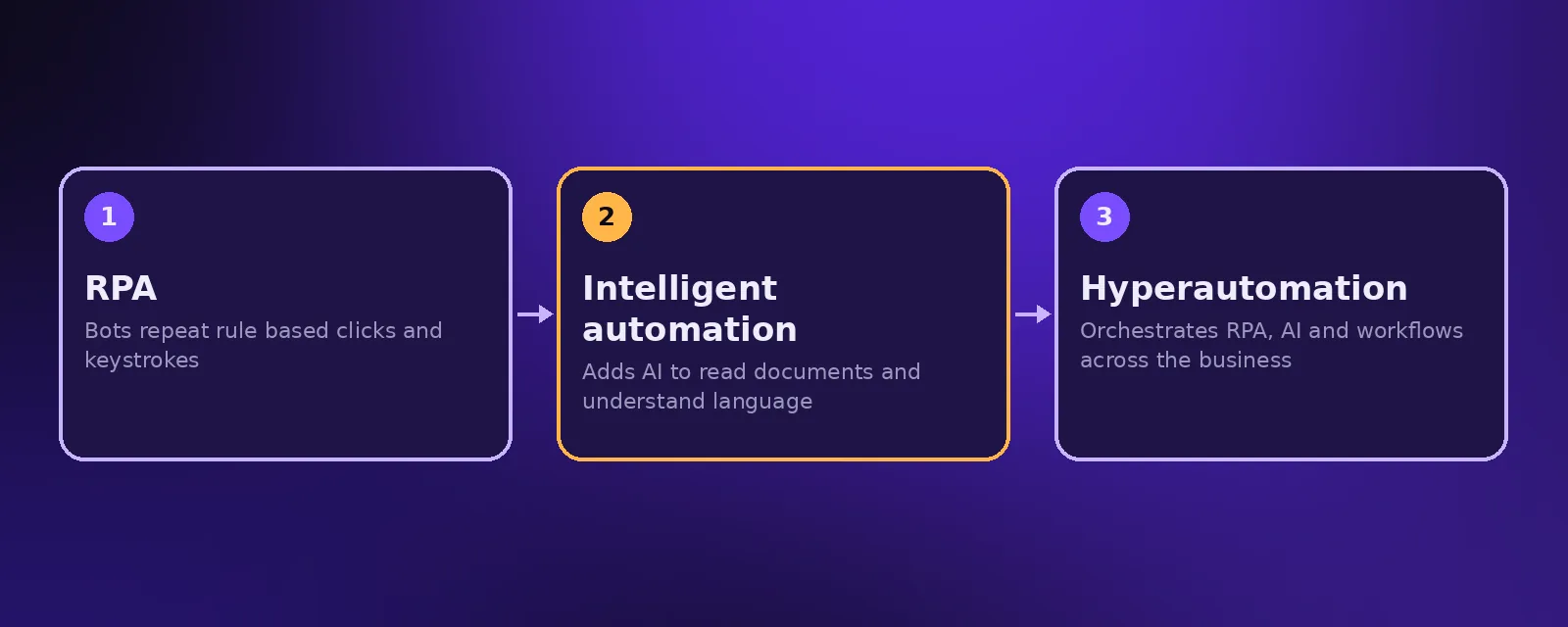
RPA vs intelligent automation vs hyperautomation
| RPA | Intelligent automation | Hyperautomation | |
|---|---|---|---|
| What it is | Bots that repeat rule based tasks | Automation plus AI | Strategy to automate at scale |
| Handles | Structured data, fixed screens | Documents, emails, conversations | End to end processes |
| Typical tools | RPA bots | Workflow tools, AI models, document AI | All of these, orchestrated |
| Best for | Legacy systems without APIs | Tasks needing reading or judgement | Organisations scaling automation |
Which one does your business need?
- If your systems have APIs, which most modern tools do, start with workflow automation using n8n, Make or Zapier. It is usually more reliable and cheaper than screen based RPA.
- If steps involve reading emails, documents or conversations, add AI to make it intelligent automation.
- Use RPA only for older systems with no other way in.
- Think about hyperautomation once you have several automations running and want a coordinated roadmap.
RPA services and intelligent automation services
Acceltor builds workflow and intelligent automation for growing businesses, connecting your systems through APIs and adding AI agents where judgement is needed. See workflow automation, custom AI tools and our guide to business process automation.
Frequently asked questions
What is the difference between RPA and intelligent automation?
RPA repeats rule based tasks, often by mimicking clicks in applications. Intelligent automation adds AI so the automation can also read documents, understand language and make simple decisions.
What is hyperautomation in simple terms?
Hyperautomation is a strategy of automating as many business processes as possible by combining RPA, AI, workflow tools and integrations, and measuring the results.
Is RPA still worth using?
RPA is still useful for older systems without APIs. For modern tools, API based workflow automation is usually more reliable and easier to maintain.
Which is best for a small business?
Most small businesses get the best results from API based workflow automation with AI added where needed, rather than traditional RPA.

Founder and CEO of Acceltor. Talha leads a team of engineers and designers building AI agents, automations, websites and apps for growing businesses.
Meet the team →