
- Workflow orchestration coordinates many automated steps and systems so they run in the right order, share data and recover from errors.
- AI orchestration does the same for AI: it decides which model, agent or tool handles each step, passes context between them and keeps people in the loop.
- Orchestration matters once you have more than a few automations or agents, because it keeps them reliable, visible and easy to change.
One automation is easy to manage. Ten automations and three AI agents, all touching the same CRM, inbox and calendar, are not. That is where orchestration comes in. This guide explains workflow orchestration and AI orchestration in plain terms, and how to tell when your business needs them.
What is workflow orchestration?
Workflow orchestration is the coordination of multiple automated tasks, workflows and systems into one reliable process. An orchestrator decides what runs when, passes data from one step to the next, waits for responses, retries failed steps and alerts someone when something needs attention.
What is AI orchestration?
AI orchestration is the coordination of AI models, agents and tools within a business process. It decides which agent handles which part of a task, gives each one the context it needs, combines their outputs, and routes decisions to a person when required.
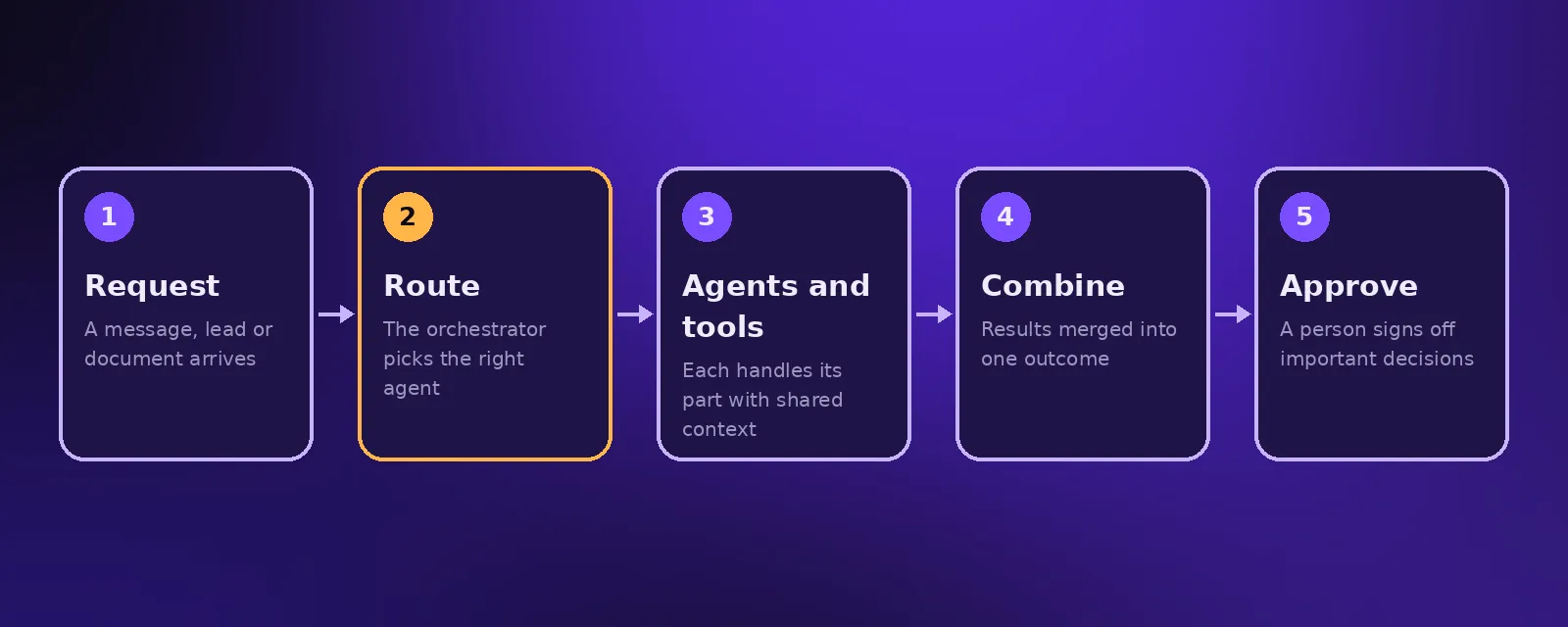
Orchestration vs automation
Automation performs a task. Orchestration manages many tasks together. A single automation might send a follow up email. An orchestrated process takes a lead from enquiry to signed contract: it qualifies the lead with an AI agent, books a call, generates a proposal, waits for a signature, creates the invoice and starts onboarding, handling errors at every step.
Examples of AI orchestration in business
- Customer support. A routing step reads each message and sends it to a billing agent, a booking agent or a person, with the full context.
- Lead handling. One agent qualifies the lead, another drafts a tailored proposal, and a workflow books the meeting and updates the CRM.
- Document processing. An extraction step reads invoices, a checking step compares them with orders, and only mismatches go to a person.
Tools for orchestration
For most growing businesses, platforms such as n8n and Make act as the orchestrator, calling AI models and agents as steps inside larger workflows. Larger engineering teams sometimes use dedicated orchestration frameworks. The right choice depends on volume, complexity and who will maintain it. See n8n vs Make vs Zapier.
Signs you need orchestration
- You have several automations that depend on each other.
- Failures in one system silently break another.
- Nobody can see the full journey of a lead or order.
- You are adding AI agents and need them to share context and hand off cleanly.
Best practices
- Keep each workflow and agent focused on one job.
- Log every step so you can trace what happened.
- Add retries and alerts for every external call.
- Keep a person in the loop for important decisions.
Acceltor designs and runs orchestrated workflows and agentic workflows for growing businesses. See workflow automation.
Frequently asked questions
What is workflow orchestration?
Workflow orchestration is coordinating many automated tasks and systems so they run in the right order, share data, retry on failure and alert people when needed.
What is AI orchestration?
AI orchestration is coordinating AI models, agents and tools within a business process, deciding which handles each step and passing context between them.
What is the difference between orchestration and automation?
Automation performs individual tasks. Orchestration manages many automated tasks, systems and agents together as one reliable process.
Can n8n be used for AI orchestration?
Yes. n8n can call AI models and agents as steps, pass data between them, handle errors and include human approval steps.

Founder and CEO of Acceltor. Talha leads a team of engineers and designers building AI agents, automations, websites and apps for growing businesses.
Meet the team →